
ISO 9001 · ISO 14001 · IATF 16949 · RoHS / REACH

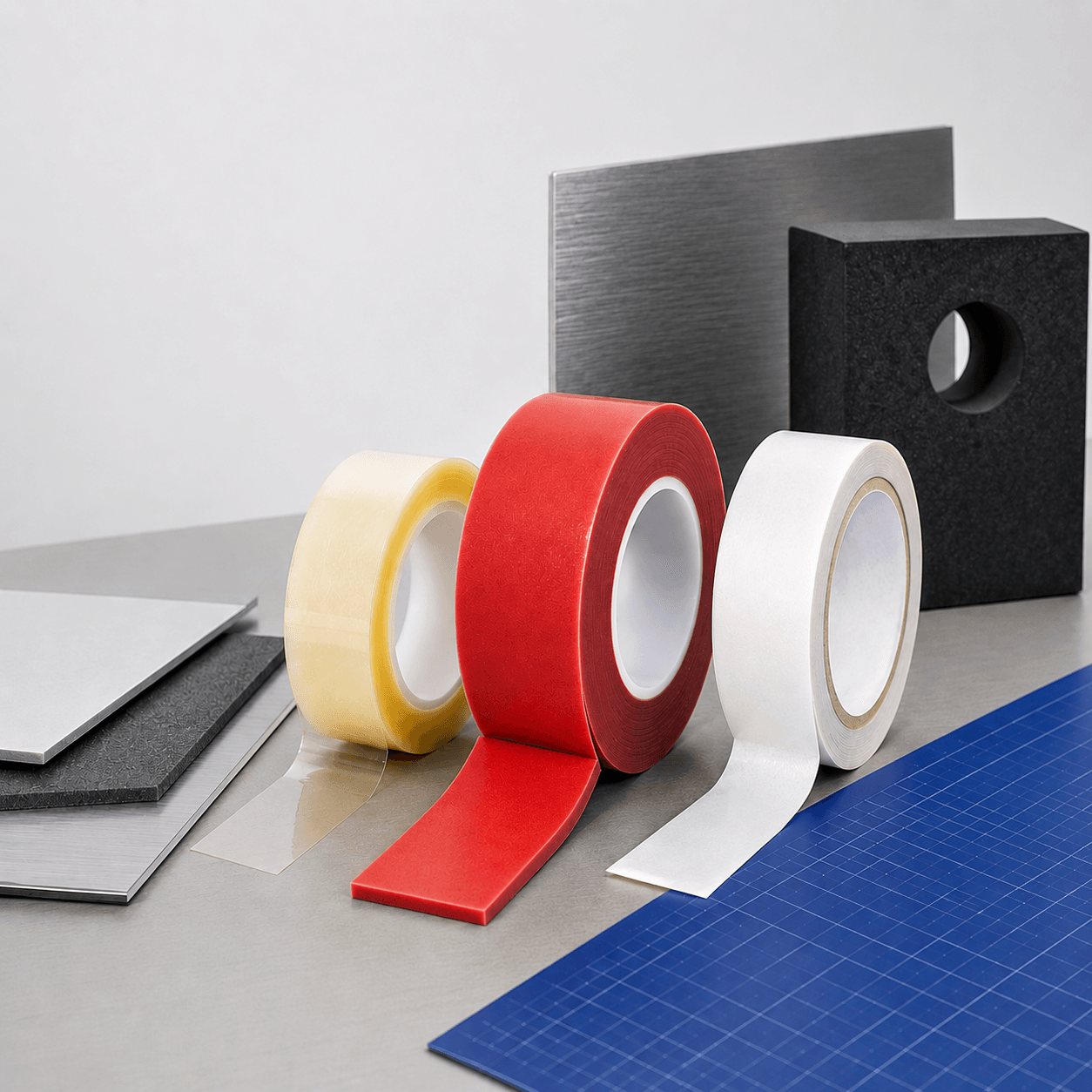
A double-sided tape rarely fails because the adhesive was weak. It fails because the wrong carrier was chosen for the surface, the gap, or the load. The carrier — the thin layer in the middle that the adhesive is coated onto — is what decides whether a tape can bridge a gap, survive heat and weather, die-cut into a clean gasket, or hold a sign flat to a wall for ten years.
So before you compare data sheets or peel-strength numbers, choose the carrier first. The three you’ll meet most often are tissue (paper), PET (polyester) film, and acrylic foam. Here’s how they differ — and a simple way to pick the right one.
What “double-sided tape” actually is
A double-sided (or “double-coated”) tape is a carrier coated with adhesive on both faces, supplied on a release liner you peel away as you apply it. The carrier gives the tape its body, strength and thickness; the adhesive does the gripping. Because the two faces can use different adhesives (a “differential” tape), one side can be tuned to stick to metal while the other grabs foam or plastic.
One special case has no carrier at all: a transfer tape is a pure film of adhesive on a liner. It’s extremely thin and conformable — ideal for laminating two flat surfaces — but it can’t carry load or fill a gap the way a foam can.
The three carriers at a glance
| Carrier | Typical thickness | Conforms / fills gaps | Bond strength | Removal / repositioning | Best for |
|---|---|---|---|---|---|
| Tissue / paper | Thin (~0.1 mm) | Some — flexible | Light to medium | No — tears | Splicing, paper & foam mounting, light bonding |
| PET film | Very thin (~0.05–0.12 mm) | Low — needs flat contact | Medium to high | Repositionable options | Die-cut parts, nameplates, electronics, gaskets |
| Acrylic foam | Thick (~0.4–3 mm+) | High — fills gaps & curves | High / structural | Permanent | Panel & trim bonding, signage, outdoor, load-bearing |
Fast answer: smooth, rigid and precise → PET film; uneven, curved, outdoor or load-bearing → acrylic foam; paper, card or light, economical jobs → tissue. The sections below explain why.
Tissue (paper) double-sided tape
The economical workhorse. A tissue or non-woven carrier is thin and flexible, so it conforms to slightly uneven surfaces and tears by hand. It’s the standard choice for splicing rolls of paper or film, mounting lightweight items, bookbinding, and general light-duty bonding where you don’t need much holding power.
Strengths: low cost, conformable, easy to handle, good for porous surfaces like paper and card. Limits: lower strength than film or foam, won’t fill gaps, and it can’t be removed cleanly — the tissue tends to split and leave residue.
PET (polyester) film double-sided tape
When you need a tape that is thin but strong and dimensionally stable, PET film is the answer. The polyester carrier resists stretching and tearing, which is exactly what you want for die-cutting clean, precise shapes — gaskets, spacers, membrane switches and parts supplied on a liner. It’s a mainstay in electronics and appliance assembly, nameplate and trim attachment, and anywhere dimensions have to stay tight.
PET tapes are often built with differential adhesives — for example a high-tack side to grab a textured housing and a removable side for repositioning. Strengths: thin, high tensile strength, clean die-cutting, good temperature range. Limits: it needs good flat contact — a thin film can’t bridge an uneven or curved gap.
Acrylic foam (high-bond) double-sided tape
This is the structural option — a thick, viscoelastic acrylic foam core coated both sides. The foam does three things film and tissue can’t: it fills gaps on uneven or curved surfaces, it spreads stress across the whole bond instead of a thin line, and it absorbs movement from vibration and the different thermal expansion of two materials. That’s why these tapes can replace rivets, screws and spot welds in many designs.
Acrylic foam bonds are weather, UV and solvent resistant, so they’re built for the outdoors: architectural panels and façades, signage and standoff mounting, automotive trim and emblems, and EV battery assembly. One thing to plan for: the bond builds over time as the adhesive wets out — it’s strong on contact but reaches full strength after a dwell period (often around 24–72 hours). If your application also needs a softer seal or cushion as well as a firm bond, look at our acrylic-foam tapes.
Strengths: very high, durable, weatherproof bonds; gap-filling; vibration and stress absorption. Limits: thicker and higher cost; permanent (not made to be removed); needs dwell time to reach full strength.
The adhesive matters too
Carrier first, but the adhesive chemistry on it is the second decision. In short: rubber adhesives give high initial tack and stick well to tricky plastics, but tolerate less heat and UV. Acrylic adhesives bond a little slower and build strength over time, but hold up far better to temperature, ageing and sunlight — the reason outdoor and structural tapes are almost always acrylic. Silicone adhesives are a specialty for very high temperatures and for sticking to silicone surfaces. (We’ll cover this trade-off in depth in a separate guide.)
Surface energy: the thing that trips people up
The single biggest reason a “strong” tape won’t stick is surface energy. High-surface-energy materials — metal, glass, PET, ABS, painted steel — let adhesive flow out and grip easily. Low-surface-energy (LSE) materials — polypropylene (PP), polyethylene (PE), powder-coated surfaces, PTFE, some rubbers — resist wetting, so a standard tape beads up and lets go.
If you’re bonding to LSE plastics, you need an adhesive formulated for LSE (a modified acrylic or a tackified rubber), or a primer to raise the surface energy first. Tell your supplier the exact material you’re sticking to — it changes the recommendation more than almost anything else.
How to choose: five questions
- What are you bonding to? Identify both surfaces and whether either is a low-surface-energy plastic. This drives the adhesive.
- Is the surface flat or uneven? Smooth and rigid → tissue or PET. Curved, rough or with a gap → acrylic foam, which fills it.
- How much load, and for how long? Light and temporary → tissue. Precise and medium → PET. Heavy, structural or long-term → acrylic foam.
- Where will it live? Indoors at room temperature is forgiving. Heat, sunlight or weather → an acrylic adhesive, usually on a foam carrier.
- Does it need to come off, or die-cut cleanly? Removable or repositionable → a film tape with a suitable adhesive. Clean, precise shapes → PET. Permanent → acrylic foam.
Quick match
- Smooth, rigid, precise parts (electronics, nameplates, gaskets): PET film double-sided tape.
- Uneven, curved, outdoor or load-bearing (signs, panels, trim): acrylic foam high-bond tape.
- Paper, card, foam, splicing or light economical mounting: tissue double-sided tape.
- Low-surface-energy plastics (PP, PE, powder coat): an LSE-grade adhesive, often on a foam carrier — and consider a primer.
- Laminating two flat surfaces with the thinnest possible bond line: a transfer tape.
Get it made for your job
As a source factory we formulate and coat our own adhesives and convert tapes in-house, and we build double-sided tapes on all three carriers — so the tape is matched to your application rather than pulled off a shelf: custom width and length, the right liner, differential adhesives, and clean die-cut parts. The surest way to choose is to test it — tell us your two surfaces, the gap and the conditions, and we’ll recommend a construction and send free samples to qualify on your own line. Full technical data sheets are available with every product on our quality & documents page.
Frequently asked questions
What is the strongest double-sided tape?
For most applications, a thick acrylic foam high-bond tape gives the highest, most durable hold, because the foam spreads stress and the acrylic adhesive builds a permanent bond. Just remember it reaches full strength after a dwell period of roughly a day or more.
Which double-sided tape works outdoors?
Choose an acrylic adhesive (not rubber) for UV and weather resistance, usually on a foam carrier so it tolerates movement and temperature swings. These are the tapes used for exterior signage, panels and trim.
Is there a removable double-sided tape?
Yes — a film carrier (PET) with a removable or repositionable adhesive on one or both sides lets you reposition or lift the part without residue. Foam high-bond tapes, by contrast, are designed to be permanent.
What about low-surface-energy plastics like PP and PE?
Standard tapes struggle on these. Use an adhesive formulated for low surface energy (a modified acrylic or tackified rubber), or prime the surface first. Always tell your supplier the exact plastic.
Double-sided tape vs “mounting tape” — what’s the difference?
“Mounting tape” usually just means a double-sided foam tape — the foam cushions and fills small gaps, which is why it’s sold for mounting things to walls and surfaces. It’s a subset of double-sided tape, not a different product.
What information should I send to get a recommendation?
To get an accurate recommendation and quote quickly, tell us: both surfaces you’re bonding (and whether either is a low-surface-energy plastic), whether the surface is flat or has a gap, the load and how long it must hold, the environment (temperature, indoor or outdoor), whether it needs to be removable, and your rough size and quantity. A photo or drawing helps. Send that over and we’ll propose a construction and ship free samples — get in touch.